Core Web Vitals audit
For teams with one or two developers who need to know what to fix first. And for anyone who wants a second opinion before they spend more time or money on it. One fixed price, done within a week.


Some of the teams I've worked with






















What an audit with me looks like
An audit answers three questions: what's slow, why, and what to fix first. I answer them with your field data, and I write the answers down for whoever builds your site. Getting a second opinion? Then I check your current plan against those answers.
-
Your field data first
I start with what your real visitors experience at the 75th percentile: the CrUX data Google uses, and your own RUM data if you have it. No RUM? Then I add CoreDash while I audit, so I can see which element, script or image each problem comes from.
-
Template by template
Then I go through the templates that make you money: home, category, product, article, checkout. I trace them in Chrome, request by request, until I know what causes each problem and which fixes depend on each other.
-
A report your developers can build from
Each finding gets the cause, the effect and the fix, with code examples. In order: what goes first, what can wait, and what only pays off once something else is done. Written for a developer, with a one page summary on top for you.
-
We go through it together
Then we sit down with whoever builds your site: your developer, your agency, or both. They can ask me anything, and they leave knowing what to build on Monday.
What does a Core Web Vitals audit cost?
One fixed price, agreed before I start. You get it within a week once I have access. If I find something big and simple on day one, you hear about it on day one.
- Me, not a junior consultant with a checklist
- Your field data and your templates, one by one
- Each problem with its cause, its effect and the fix
- Code examples your developer or agency can use
- The fixes in the order to build them
- A call to go through it with whoever builds your site
One fixed price
Up to 4 page types, like home, category, product and checkout. Several domains, a lot of languages or a big platform? Then the scope tells you what it costs.
€1,500 fixedwithin a week
Request an audit
Send me your URL and a line about what's going on. I mail you back and we agree on the scope: which page types, what needs extra care, the price and a delivery date. You say yes, I start.
-
Tell me about your site
Your URL and what's bothering you. Before I reply, I go through your field data and your main templates to get a first idea of what's wrong.
-
We agree on the scope
Within a day you get what I've seen and a few questions. Your answers decide which page types I audit, what needs extra care, the price and a delivery date.
-
You say yes, I start
Within a week of getting access you have the report, and we go through it with whoever builds your site.
Who is a Core Web Vitals audit for?
One or two developers
For a team that size, months of consultancy is usually more than the problem needs. What helps them is knowing where to look and in what order. The audit gives them that, and a call where they can ask me the questions they couldn't google.
An audit for a client's site
You build the site, and your client sees red in Search Console. I audit it, write the findings so your developers can build them, and go through them with your team. Your client gets a faster site from the agency they already work with. For ongoing work there's agency support.
Before you spend more on it
Someone proposed a rebuild, a new theme or a plugin that promises to fix everything, and you're not sure. I check that plan against your field data and tell you whether it fixes what's slow for your visitors, or what I'd do instead.
What an audit looked like at Voices
A WordPress marketing site, a separate app for voice actor profiles, a blog and podcasts
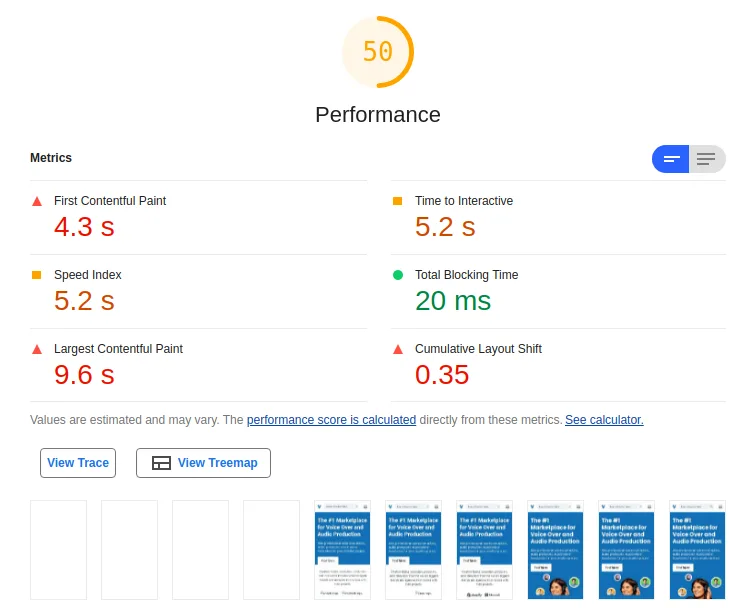
Voices is where companies hire voice actors, and their site was really three sites: a WordPress marketing site, a separate app for the voice actor profiles, and a blog and podcasts. I went through about 25 URLs across all of them. On the homepage the layout jumped three times while it loaded: a fallback font swapped to Roboto, a hero image without dimensions pushed everything down, and then Roboto swapped to Poppins.
The blog looked fine on paper. It scored 94 in Lighthouse, because an optimization plugin held back the scripts for about four seconds. That fools the test and does nothing for real visitors, so my first advice for the blog was to take it out.
Then I sat down with their developers. I told them how to fix the most pressing problems first and taught them a few things along the way. It saved them from finding out what works the hard way. A while later their development manager mailed me the list: scripts moved to the footer, duplicate fonts removed, font-display fixed, fetchpriority on the images that matter. They took it and went flying.
That was 2022. The numbers above are their real mobile visitors over the last 28 days, four years later.
Questions I get asked

The audit
What is a Core Web Vitals audit?
I find out what's slow on your site for real visitors, why it's slow, and what to fix first. It's based on your field data, the same data Google uses, not on a lab test. You get the findings in writing, and we go through them with whoever builds your site.
Is a PageSpeed audit the same as a Core Web Vitals audit?
Not quite. Most PageSpeed audits start from a Lighthouse score: one simulated phone, one run. I start from what your real visitors experience at the 75th percentile, because that's what Google looks at. I still run lab tests, but only to find out why something is slow, not to decide whether it is.
Do you only look at LCP, INP and CLS?
No. A web performance audit that stops at three metrics misses the causes. TTFB, render-blocking CSS, fonts, third-party scripts and the order things load in are where most problems start. They're in the report too, in the order they matter.
Why not just run PageSpeed Insights ourselves?
You can, and you should. It tells you that you fail and roughly where. It doesn't tell you why the browser finds your LCP image late, which script is on the main thread when someone clicks, or which of its suggestions won't move your field data at all.
Your site
Our site runs on Shopify or WordPress. Can you audit it?
Yes. On a hosted platform you can't change the platform itself, but the theme, the apps and the scripts they add are yours, and most of the problems are in there. The same goes for a WordPress theme and its plugins.
Can you audit a site that isn't live yet?
Yes, on staging. Without real visitors there's no field data, so I lean on lab tests and on what I've seen break on similar sites. Once it's live, the field data tells us if I was right.
What do you need from us?
Your URL and the page types you care about. Access to Search Console and your analytics helps, and so does access to the code, but it isn't required. Most of what I need happens in the browser.
Scope and price
What does an audit cost?
€1,500 for up to 4 page types, like home, category, product and checkout. Several domains, a lot of languages or a separate web app next to your marketing site? Then the scope tells you the price before I start. No hourly meter.
How long does it take?
Within a week of getting access. Bigger sites take longer, and the scope says how long before I start.
Do we need a call first?
No. You request an audit and I mail you back with the scope. Would you rather talk first? Say so in the form and we'll do 20 minutes.
After the audit
Do you fix the problems yourself?
No. The audit tells you what to fix, and your developer or agency builds it. If you want me there while they build, that's consultancy.
Our site is built by an agency. Does that work?
Yes. I write the findings so a developer who has never met me can build them, and I'm happy to go through them with the agency directly. They get specifics, you get something to check them against.
What if questions come up while they build?
Mail me. A fix that turns out harder than it looked, or a result that doesn't match what I expected: that's part of the audit, not an extra.
How often should we get an audit?
Usually once, and again after a redesign, a new theme or a platform migration. With RUM and alerts you know when something gets slower, so you don't need a web performance audit every year.

