
Core Web Vitals training
Two hours with your web team, on your own pages. Fixed price, no seat limit.






What a masterclass with me looks like
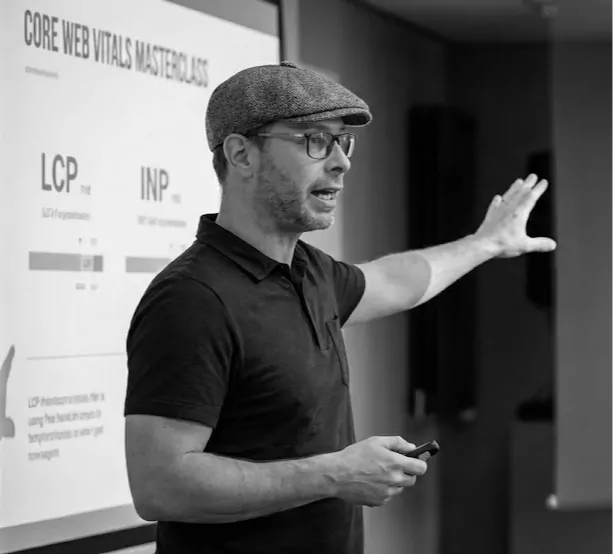
A masterclass teaches your team to find the problem. We usually spot one or two things on your site along the way, and your developers can pick those up the same week. If you'd rather have every fix written down for you, that's an audit.
-
Built around your site and your cases
Send me your URL, the pages your team works on most and the problems they're stuck on. I check p75 for LCP, INP and CLS on mobile, which page group Search Console flags, and the trend over the last months. Then I record traces of those pages. That takes me about half a day.
-
Two hours with your team
In the first hour I explain how the browser loads your pages and handles a tap, on the traces I recorded. Then one of your developers shares their screen and drives, and I tell them where to click. Invite everyone who builds the site. If someone else runs the tag manager, bring them too.
-
The recording and the notes
You keep the recording and the slides. Within a few days you also get notes on what we found, most important first. Whoever missed the session can catch up from those.
-
A follow-up, a month later
Optional. By then your team has tried it on their own and knows where they got stuck. They bring their traces and set the agenda for another two hours.
What your developers can do after the training
- Field data
Read the numbers Google looks at
Lighthouse says 95, Search Console says failed. Lighthouse is one simulated phone on one page load. Google looks at your real visitors at p75, and on mobile. Your team learns to read both, and which PageSpeed Insights audits won't move the field data. Use efficient cache lifetimes often lists Google's own tag scripts, and nobody can change their cache headers.
- LCP
Find out why the LCP element shows up late
We find the LCP marker in the Performance panel and walk back to the request. The subparts tell you whether the browser found the image late, loaded it slowly, or had it and still didn't paint it. When it was found late, it's usually a CSS background or a slider script that adds it, and compressing the image won't win that back.
- INP
Name the script behind a slow interaction
"INP issue: longer than 200ms (mobile)" has been in Search Console for months, and the trace shows a call stack full of minified function names. We take one slow interaction and split it into input delay, processing and presentation. Long Animation Frames name the script. Often it's a click handler that re-renders half the page, or an analytics event that runs before the next paint.
- CLS
Find where a layout shift starts
A layout shift is an element on the page moving when nobody expected it to. The element that moved rarely caused the shift. Something else made it move, like an image without a width and height, a script that adds content above it, or a web font that swaps in.
- Third parties
Put a number on each tag
Your developers don't own the tag manager, so every new pixel lands on the page without a ticket. Your team learns to measure each one, in a trace and in the INP of your real visitors. That number is what you take to marketing.
- Releases
Check a release the day after
LCP crept up after a deploy and nobody noticed until Search Console sent the email. Search Console shows the last 28 days, so by then the release that caused it is weeks old. RUM shows it the next day, in CoreDash or whatever you already run.
What clients say

Jamie Oliver Group
"After the training we finally understood why our INP was failing, and which interactions we had to make cheaper."
Nicole Keep

Loop
"Arjen somehow makes LCP optimization sound simple. We used his approach and our metrics were 40% better within a week."
Nathan Ziarczyk

DPG Media
"Arjen can explain the most complicated performance problems, and you can tell he loves this stuff. It made learning the hard parts fun."
Ashkan Malekloo
What does a Core Web Vitals training cost?
€1,500 for the masterclass, fixed, for the whole team. Five developers or fifteen, same price. The follow-up is €750 for another two hours. There's less to prepare, so it's about the hourly rate of a power hour.
- Me, and 17 years of reading traces
- Your p75 on mobile checked before we start
- No seat limit
- One of your developers at the keyboard in the second hour
- The recording, the slides and the notes
Two hours, your whole team
Preparation included.
€1,500 excl. VATfollow-up €750
Book a masterclass
Send me your URL and a line about your team.
-
Tell me about your team
How many people, what you build with, and which problem keeps coming back. If there's a deadline, like a big release or Black Friday, mention it.
-
We pick a date
I reply within a day with a few dates. I need about a week to prepare, so the first one is usually a week or two out.
-
On the day
Google Meet, Zoom or Teams, whatever your team uses. Make sure one developer has the site open in Chrome. They drive in the second hour.
What a training looked like at Speak
A Dutch digital agency that builds sites for its clients
Clients ask their agency about Core Web Vitals all the time: why Search Console is red, whether the new theme will fix it. Speak wanted their own developers to have the answer, so I trained the team on their own client sites.
A year later Sander Los mailed me: "Thanks to the concepts and suggestions from the training, our page speed and user experience have improved significantly." His team had rebuilt a client's webshop with what they learned.
For an agency, performance then becomes work you can quote for, and some agencies charge more for it.
Questions I get asked

The masterclass
What is a Core Web Vitals masterclass?
Two hours of training for your web team on a video call, on your own pages. By the second hour your own developer is the one recording the traces.
Do our developers need to know performance already?
No. They need to know HTML, CSS and JavaScript and have opened DevTools before. Reading a Performance trace is what I teach. A product owner or a marketer can follow the first hour fine.
Can you cover all of that in two hours?
Not in equal depth. Whichever metric fails on your site gets most of the two hours, and the rest gets enough to know where to look. For INP that includes breaking up the work in a click handler with scheduler.yield().
We use Next.js. Does that matter?
The browser doesn't care what built the page, so it works the same for Next.js, Nuxt, Magento, Shopify or WordPress. And since the examples come from your site, your framework is in them: hydration blocking the first tap on a Next.js page, or a Shopify app loading its script on every template.
Your team
How many people can join?
As many as you like. The price is per team. Above 20 people the second hour gets crowded around one screen, so we talk about the format first.
We're an agency. Does this work for us?
Yes. Pick the client site your team knows best, or the one that's failing right now. For a client site your team can't get green after the training, there's agency support.
Can you come to our office?
Yes, with a kilometre fee on top. Online works just as well, because everyone sees the trace on their own screen.
Price and afterwards
Is two hours enough?
For learning to read a trace, yes. Fixing the site happens in your team's sprints afterwards, and the follow-up is for whatever they get stuck on.
Can we book a longer training?
Yes. A half day, a full day, or a series with one session per metric. Anything longer than the masterclass gets a scope with the price before we start.
How is this different from an audit?
An audit is me finding the problems and writing them down, and your team builds the fixes. The masterclass teaches them to find the problems themselves, which pays off most for a team that will work on the same site for years. With a deadline coming, start with the audit.
What if we get stuck afterwards?
Book the follow-up, or a power hour for one hard problem. If it's bigger than that, an audit or consultancy.

