Speak: a client's webshop from orange to green, a year after the training
A Dutch agency. I trained their developers, and in September 2024 a client's webshop they rebuilt went live.
Speak, an agency in Heerenveen that builds sites for its clients
Speak builds sites for its clients, and those clients ask about Core Web Vitals. In 2023 I trained their developers for three hours, on sites they had built, with the field data of those sites.
Afterwards they came back with questions about client sites, by mail, for a while, until they could answer them themselves. Later they booked a 4-hour block: I found the LCP bottleneck in the first session and spent the rest of the time teaching the team to read LoAF traces. Their engineering manager: "Our engineers now catch regressions before they reach production."

A client's webshop, rebuilt with what they learned
In November 2024 Sander Los, one of their developers, mailed me the CrUX graphs of a webshop they had rebuilt. The changes went live early in September.
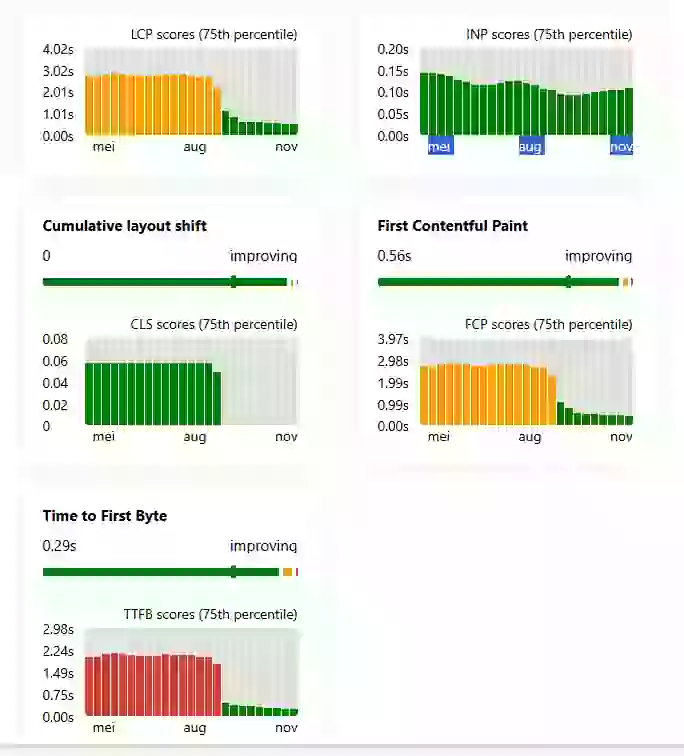
Scripts that load on interaction, and a test that sometimes interacts
They load the cookie banner, the tag manager and the slider library only when a visitor interacts. Real visitors get a fast first screen. But PageSpeed Insights sometimes fired an interaction of its own, a mouseover, and then loaded all of it anyway. So the score depended on whether the test happened to fire an event.
I sent them a small script that writes every interaction the test fires onto the page, so they could see it happen. Then we went through it together on a call.
"Thanks to the concepts and suggestions from the training, our page speed and user experience have improved significantly."
Sander Los, Developer, Speak
Clients look at the Lighthouse number
Real visitors got a fast first screen. Their clients opened PageSpeed Insights. At an agency the developers have to understand both: what real visitors get, and what the test does.
Training sticks on their own client sites
Every example was a site they would open again the next week.

Your clients send you their PageSpeed score?
Two hours with your whole team on your own client sites, €1,500 fixed. The follow-up is €750 for another two hours.
More results on my clients page.

